




The New EU Right to Repair Takes Effect: How Should Businesses Rebuild After-Sales Service?
Published: Updated:
I. Legislative Timeline: From Draft to Full Effect
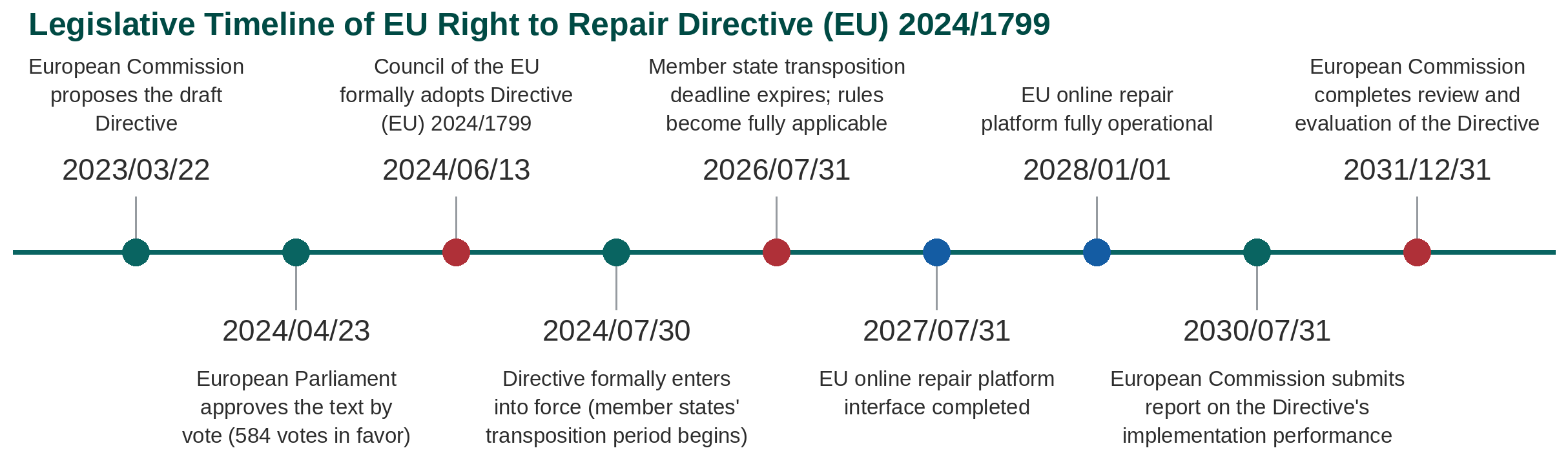
Back in March 2023, when the European Commission first floated its Right to Repair (R2R) proposal, the industry reacted with alarm. Two years on, the legislation has completed the full process: the European Parliament and Council jointly adopted it on 13 June 2024, formally named Directive (EU) 2024/1799, which entered into force on 30 July of that same year. For businesses, there is one date that matters above all others: 31 July 2026. From that day, every Member State must have transposed the directive into national law, and the related measures take effect.
1.1 What Is Germany Doing? Stricter Than the EU Baseline | ||||
On 15 January 2026, Germany's Federal Ministry of Justice and Consumer Protection published a ministerial draft intended to amend the German Civil Code (BGB) and the Introductory Act to the Civil Code (EGBGB) to transpose the directive. It is currently expected to pass between late June and early July 2026, putting Germany on track to meet the deadline. But Germany's approach goes further than the EU's parent legislation: it directly defines "unrepairability" as a "material defect" in the product. In other words, if a product simply cannot be repaired, that in itself is treated as a defect in the product. Notably, this rule is not limited to B2C transactions — B2B transactions are covered as well. Why is Germany able to go this far? Because EU law already left room for it. Article 16(1) of the directive amends the Sale of Goods Directive (EU) 2019/771, formally adding "durability, repairability, functionality, and compatibility" to the criteria for determining whether goods "conform to the contract." This means that, starting 31 July 2026, manufacturers bear a repair obligation for products within scope — even if the washing machine in question was purchased by the consumer back in 2022. The repair obligation is tied to how old the product is, not to when the contract was signed. Businesses can no longer use the excuse that "the rule wasn't in force at the time." | ||||
1.2 What Comes Next? | ||||
➤ | 31 July 2027: The Commission must establish the common interface for the "European Repair Matchmaking Platform" (Article 7). | |||
➤ | 31 July 2029: Each Member State must report at least one concrete measure promoting repair (Article 13). | |||
➤ | 31 July 2031: The Commission submits an overall review report assessing whether the system is actually working (Article 19). | |||
Figure 1 – Legislative Timeline of the EU Right to Repair | ||||
1.3 Penalties and Enforcement: A Single Country's Fine Is No Longer Enough — Now It's Cross-Border Cooperation | ||||
The directive itself does not set a specific fine amount. Instead, it leaves that power to each Member State, requiring them to establish penalties that are "effective, proportionate, and dissuasive" (Article 15). That sounds flexible, but in practice it's a headache for businesses — you have to check local penalty standards country by country, with no single unified answer. Article 18 is another key mechanism: it amends the Consumer Protection Cooperation Regulation (EU) 2017/2394, folding the repair obligation into the cross-border Consumer Protection Cooperation (CPC) Network. In practice, this means that if a systemic violation is identified in France, Germany's competent authority can also step in and investigate through this mechanism. This move by the EU addresses the long-standing problem of consumers having "no cross-border recourse." |
II. What Structural Problems Does the New Right to Repair Solve? Reading the System Design Through Consumer Concerns
When consumers faced a broken product in the past, the issue was often not that they "didn't want to repair it," but that they simply "couldn't get it repaired." EU research found consumers stuck on three real-world problems:
➤ | Psychological factors: "Replace it when it breaks" has become the default social assumption, and 16% to 59% of consumers admit they lack the confidence to repair things themselves [4]. | |||
➤ | Service and resource accessibility: About 30% of respondents have no idea there is any repair service near their home, and 62% of repair cases are interrupted due to missing parts — a problem that usually traces back to an information gap between the brand and its upstream OEMs, not to the repair technician [4]. | |||
➤ | Cost perception gap: "Repairs are too expensive" is the most commonly cited reason, but research shows no significant correlation between actual financial circumstances and repair behavior. "Expensive" is mostly an unverified assumption — what really drives up costs is that product design never factored in repairability from the outset [4]. | |||
These three problems are interlinked: not knowing where to get something repaired makes it impossible to judge whether repair is worthwhile; even if a technician is found, missing parts or opaque pricing still stall the repair; and technical barriers at the software and contract level fundamentally shrink the space in which independent repairers can operate. The European Commission estimates that if repair rates were effectively raised, roughly 35 million metric tons of waste could be avoided each year. A European Council survey also shows that 77% of EU consumers prefer to repair rather than replace outright. The problem was never a lack of consumer willingness — it was the system design [3]. The following four items are the concrete response mechanisms the new Right to Repair Directive designed to address exactly these structural problems:
2.1 "Would Repairing Cost More Than Buying New?" — Information Is Finally Transparent | ||||
How consumers judge whether repair is "worth it" depends heavily on how the information is presented. Research found that if consumers are simply told "spare parts remain available long-term," they're willing to pay a bit more; but if the unit price of the spare part is shown directly, willingness to pay actually drops. The directive's solution is to mandate the creation of a "European Repair Information Form" (Article 4). Before a contract is finalized, repairers must clearly disclose conditions such as price, repair time, and parts availability — and these terms cannot be changed arbitrarily within 30 days. Paired with the "European Repair Matchmaking Platform" (Article 7), consumers can directly compare prices and read reviews, finally putting an end to guesswork. This information-transparency mechanism also echoes prevailing consumer sentiment, as the survey results below illustrate.
Figure 2 – "Should manufacturers be required to make digital devices easier to repair?" [3] |
![Figure 2 – "Should manufacturers be required to make digital devices easier to repair?" [3]](/up/260728/album/1785229589329732.png "Figure 2 – \"Should manufacturers be required to make digital devices easier to repair?\" [3]")
2.2 "What If I Can't Find Parts or Can't Get It Fixed?" — Manufacturers Can No Longer Look Away | ||||
The shortage of parts, tools, and repair guides usually stems from a supply-chain gap between manufacturers and upstream OEMs — something no single repairer can fix on their own. The directive therefore places clear, direct obligations on manufacturers: | ||||
➤ | Article 5(4): Manufacturers must supply spare parts and tools at a "reasonable price that does not discourage consumers." | |||
➤ | Article 5(5): Reference prices for typical repairs must be published on a free website, ensuring price transparency. | |||
➤ | Article 5(6): Repair may not be deliberately obstructed through contract clauses or hardware/software technology. Independent repairers may use original, second-hand, compatible, or even 3D-printed parts. | |||
➤ | Article 5(7): A repair request may not be refused simply because the product has previously been repaired by someone else — precisely to close the loophole of using "deemed unrepairable" as a pretext. | |||
The product categories currently within scope of this obligation are as follows: | ||||
Table 1 – Annex II Product Categories and Applicable Ecodesign Regulations [1] | ||||
![Table 1 – Annex II Product Categories and Applicable Ecodesign Regulations [1]](/up/260728/album/1785229609178978.png "Table 1 – Annex II Product Categories and Applicable Ecodesign Regulations [1]")
2.3 "Does the Warranty Reset After a Repair?" — This Time It Really Does Extend | ||||
The directive addresses this concern through two mechanisms: | ||||
➤ | Article 5 grants consumers the right to request repair directly from the manufacturer, even after the seller's two-year statutory warranty has expired. This is the first time a private-law obligation has been established allowing consumers to seek recourse directly against manufacturers. | |||
➤ | Under the amended Article 10 of Sale of Goods Directive 2019/771, if a consumer chooses repair over replacement, the warranty period is automatically extended by 12 months. For consumers, this is a real incentive; for businesses, it's a hard rule that must be built into system design. | |||
2.4 "The Manufacturer Is Abroad — Who Do I Turn To If Something Goes Wrong?" — A Three-Tier Fallback Liability Chain | ||||
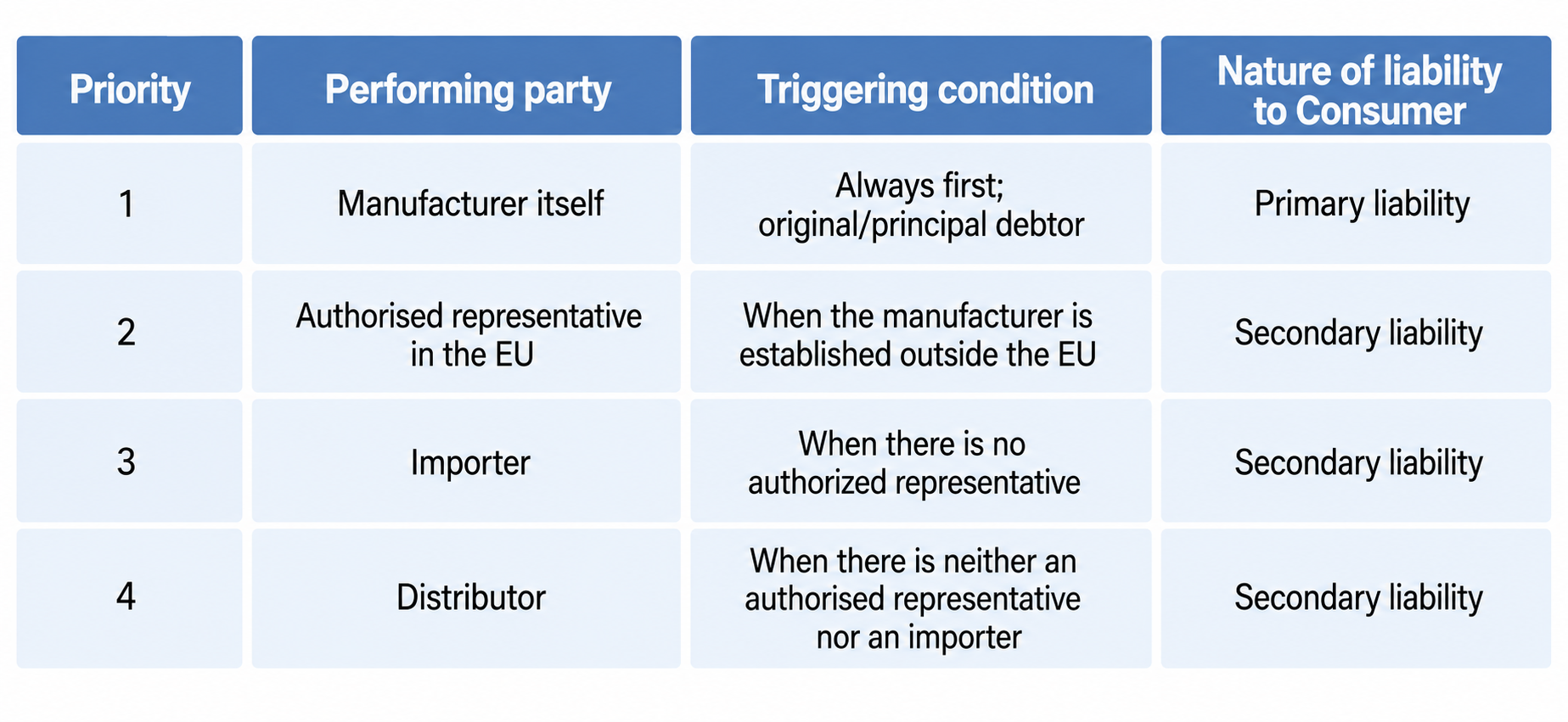
Most electronics supply chains are inherently cross-border. In the past, when a manufacturer was based outside the EU, it was practically very difficult for consumers to assert their rights. Article 5(3) of the directive establishes a "fallback liability chain": the manufacturer's authorized representative within the EU → the importer → the distributor. These "economic operators" step in sequentially and bear secondary liability toward the consumer (meaning the manufacturer remains the primary obligor, and the economic operators are only responsible if the manufacturer fails to perform). Consumers no longer need to go through the trouble of contacting an overseas manufacturer directly — they can request repair from a liable party within the EU [1][5]. The figure below illustrates the structure of this fallback liability chain, along with the legal relationships that remain to be clarified when consumers assert their rights against each economic operator.
Figure 3 – Fallback Liability Chain of EU-Based Economic Operators (From the Consumer Recourse Perspective) [5] | ||||
![Figure 3 – Fallback Liability Chain of EU-Based Economic Operators (From the Consumer Recourse Perspective) [5]](/up/260728/album/1785229516855102.png "Figure 3 – Fallback Liability Chain of EU-Based Economic Operators (From the Consumer Recourse Perspective) [5]")
III. What Does This Mean for Manufacturing Companies?
3.1 From "Pay Damages and Move On" to "Must Actually Fix It" | ||||
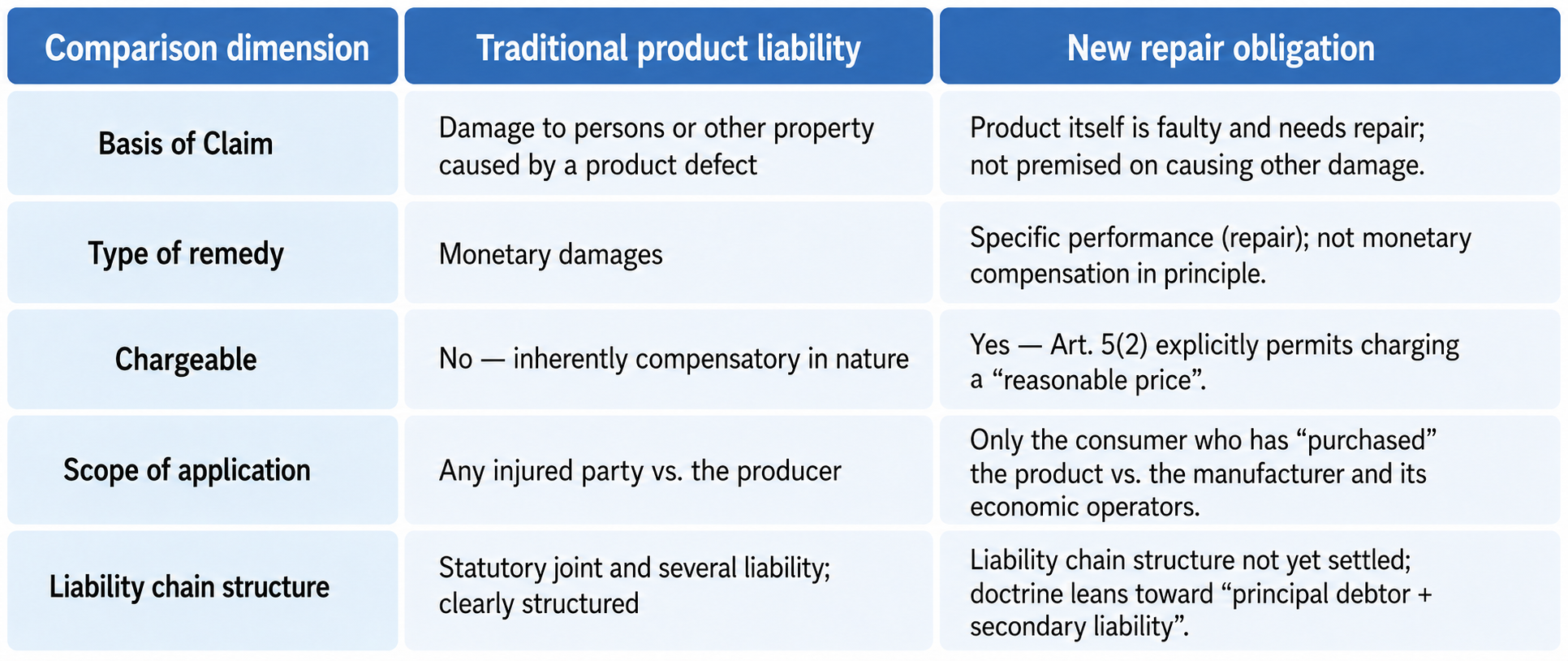
The direct manufacturer repair obligation established under Article 5 of the Right to Repair Directive is quite rare within legal systems. In the past, the only direct link between consumers and manufacturers existed through "product liability" — a framework centered on damages for harm. But product liability means "pay damages after something goes wrong," whereas the repair obligation means "you must actually fix it after something goes wrong." The two are fundamentally different in nature, and the distinction is summarized in the figure below: | ||||
Figure 4 – Comparison of Traditional Product Liability and the New Repair Obligation | ||||
The product liability insurance and recall mechanisms that businesses are familiar with cannot simply be applied to this new type of obligation. It is closer to a "compulsory service obligation" than to a simple after-the-fact remedy for damage. | ||||
3.2 The Liable Party Is No Longer Just the "Seller" | ||||
In the past, when consumers encountered a product defect, they mainly turned to the seller. Now, even after the seller's two-year statutory warranty has expired, the consumer can still request repair directly from the manufacturer. No matter how many layers of distribution and resale a product has passed through, this direct right of request is not diluted. Companies need to reassess their own repair-service capacity and evaluate whether they already have sufficient internal or outsourced repair networks to directly handle repair requests from consumers across the EU, rather than continuing to rely on the traditional one-way "seller → consumer" communication model. |
3.3 Overseas Manufacturers Must "Find Someone to Answer For It" Within the EU | ||||
Article 5(3) of the directive provides that, if a manufacturer is based outside the EU, the repair obligation must be taken over in sequence by the authorized representative, the importer, and the distributor within the EU. While the text does not explicitly state whether this is "joint liability" or "secondary liability," under the spirit of the legislative explanation, the manufacturer remains the primary obligor; once it fails to perform, consumers can go directly to the economic operator within the EU without needing to go back and forth with an overseas headquarters. The overall order of liability performance is shown in the figure below: | ||||
Figure 5 – Order of Liability Performance Among the Three Tiers of Economic Operators | ||||
Non-EU manufacturers should proactively confirm who their authorized representative in the EU is, and ensure that importers and distributors are aware of the liability they may bear. Commercial contracts should, at minimum, clearly spell out three things: | ||||
➤ | Who performs the repair obligation, and how. | |||
➤ | Who fronts the repair costs first, and how they are recovered from the manufacturer. | |||
➤ | If a consumer sues the distributor directly, how the distributor obtains the manufacturer's technical support and a guarantee of parts supply. | |||
3.4 Cross-Border Litigation: A Last Line of Defense, Not a Systemic Safeguard | ||||
Even if the "consumer jurisdiction" route above cannot be applied due to case-specific disputes, consumers can still first bring an "anchor action" against the economic operator within the EU, then attempt to pursue the overseas manufacturer under each country's "related-claims jurisdiction" rules. However, the related-claims jurisdiction under the Brussels Ibis Regulation only applies to combined proceedings among defendants within the EU, and whether it succeeds still depends on how each country's domestic law interprets it. This path is a "non-uniform, unstable" fallback route — not a systemic safeguard. Rather than banking on a jurisdictional loophole, it is better to proactively build local EU repair capacity and put the focus of compliance on "proactive performance" rather than "reactive litigation defense" [5]. | ||||
Corporate Action Guide — Next Steps for Decision-Makers
Looking back over this article, what the new Right to Repair Directive is really responding to is not simply "extending the warranty" — it is four long-standing structural gaps: opaque information, broken parts supply chains, technical barriers, and the absence of cross-border recourse. With the 31 July 2026 deadline approaching, rather than treating the repair obligation as a one-off compliance task, businesses should treat it as an opportunity to redesign after-sales service management. The following three directions are concrete actions decision-makers can prioritize going forward: | ||||
1. | Re-examine Product Design and the Supply Chain | |||
➤ Ensure components are modular and highly repairable. | ||||
➤ Conduct a comprehensive review and remove any non-compliant hardware or software anti-repair locks. | ||||
2. | Pricing and Spare Parts Strategy | |||
➤ Establish a pricing model for parts and tools that is "reasonable and non-obstructive." | ||||
➤ Actively develop a refurbished-goods business as a legitimate alternative when repair is not possible. | ||||
3. | Service Transformation and Compliance Readiness | |||
➤ Turn "repair" from a cost center into a new engine for boosting brand loyalty and accessing subsidies. | ||||
➤ Immediately prepare to roll out standard operating procedures and digital systems for the European Repair Information Form (Annex I). | ||||
The right to repair is no longer just a consumer-protection clause — it is a watershed moment reshaping the rules of Europe's after-sales service market. From product design and pricing strategy to service workflows, every link in the chain affects whether a business can stand firm once the new regime takes effect. Rather than passively reacting to penalty and class-action risk, companies would do better to seize this transition period and internalize the repair obligation early on as part of their brand value — this is the most practical reminder the new Right to Repair Directive leaves for businesses. | ||||
Author
Wareconn Editorial Department

The New EU Right to Repair Takes Effect: How Should Businesses Rebuild After-Sales Service?.pdf
Reference
- Directive (EU) 2024/1799
- Directive (EU) 2020/1828
- Right to repair - European Parliament
- ScienceDirect - Perspectives from the broken electronics repair system: Barriers and enablers along the repair journey
- SSRN eLibrary - Claiming the EU Right to Repair from Manufacturers in Cross-Border Contexts
- Claimlane - EU Right to Repair: What Brands Must Know (2026)
- Journal of Circular Economy (2025) 3:3, 274-295 - Repair Over Replacement: Consumer Behaviours and Repair Practices for Electronics in the Global South
- JITTC - The right-to-repair movement: Sustainability and consumer rights
- Intelligent Living - EU Right to Repair Goes Live July 31, 2026: How Warranty Extensions, Repair Quotes, and Spare Parts Turn Fixing into the Default
- complyMarket - EU Right to Repair Rules: Practical Compliance Guide


